Hamlet — William Shakespeare
A prince returns from university to find his father dead, his mother hastily remarried to his uncle, and a ghost demanding revenge. What follows is not a swift act of vengeance but a prolonged, agonizing investigation into the nature of action, thought, performance, and death — the most psychologically complex character study ever written for the stage.
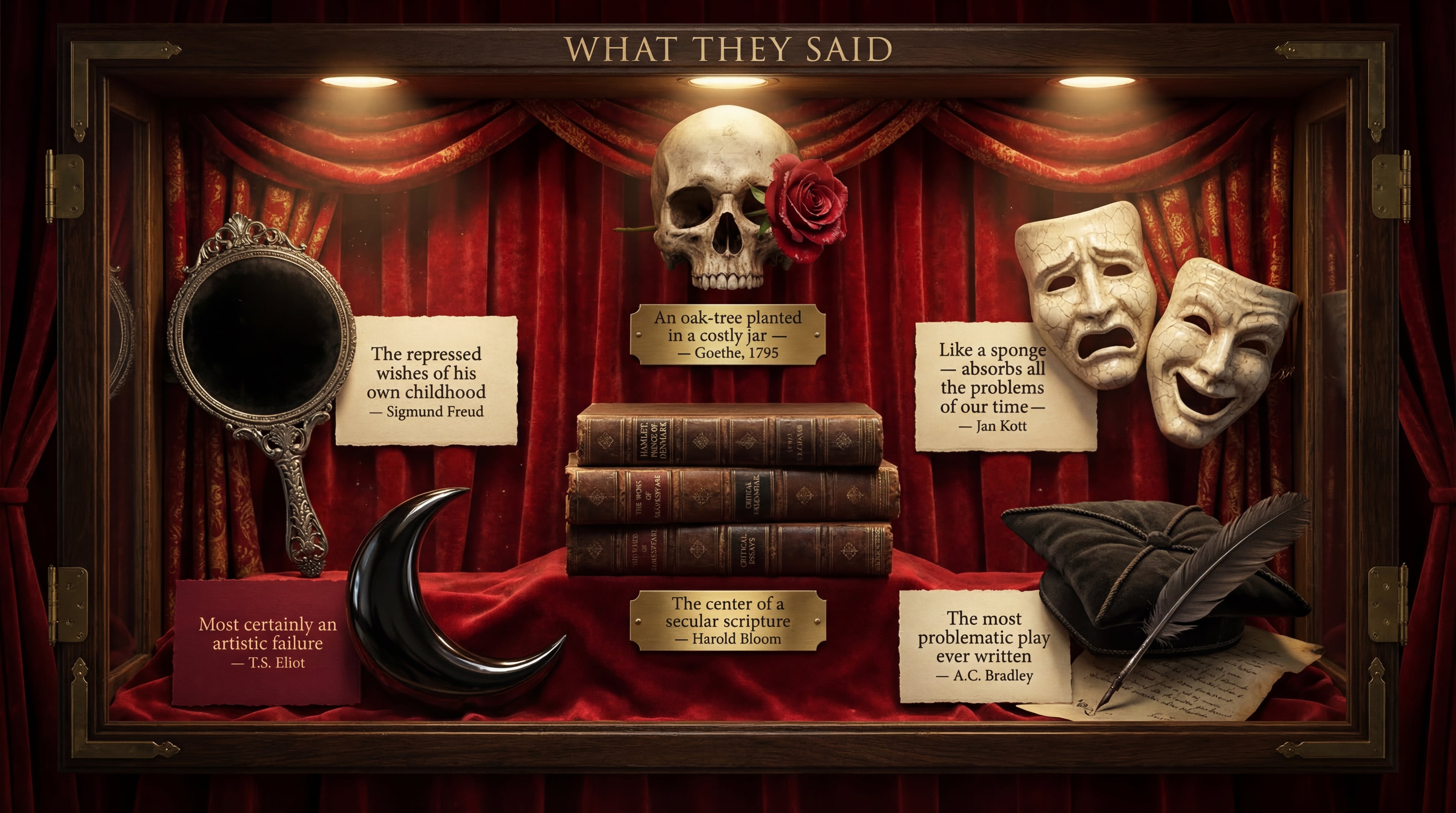
The most-performed, most-studied, and most-quoted play in history. Hamlet invented the modern literary character — a figure who watches himself think, doubts his own motives, and transforms through self-awareness. Every generation since has found its own Hamlet: Romantic hero, Freudian neurotic, existentialist rebel, postcolonial subject. The play is, as Jan Kott wrote, 'like a sponge' — it absorbs all interpretations and remains inexhaustible.
A lovely, pure, noble and most moral nature, without the strength of nerve which forms a hero, sinks beneath a burden which it cannot bear and must not cast away — an oak-tree planted in a costly jar.
In Hamlet he seems to me to be a man who is the prevalence of the abstracting and generalising habit over the practical.
Hamlet is dominated by an emotion which is inexpressible, because it is in excess of the facts as they appear. So far from being Shakespeare's masterpiece, the play is most certainly an artistic failure.