The 30,000-foot view
After ten years of war at Troy and ten more years of wandering, Odysseus struggles to return home to Ithaca, his faithful wife Penelope, and his son Telemachus. Beset by the wrath of Poseidon, tempted by goddesses and monsters, and forced to descend to the kingdom of the dead, he must use cunning, endurance, and the favor of Athena to reclaim his household from the suitors who devour his wealth and court his wife. It is the original story of homecoming -- and the discovery that home, like the self, must be earned back.
The Odyssey emerged at the dawn of Greek literacy, when the oral bardic tradition was being committed to writing for the first time. Composed in the aftermath of the Greek Dark Ages, it encodes the values of an aristocratic warrior culture transitioning to the settled world of the polis. Where the Iliad sings of war and glory, the Odyssey invents the literature of return, identity, and cunning intelligence (metis). It established the narrative archetype of the journey home that runs through Virgil, Dante, Joyce, and Walcott.
The Odyssey invented the Western literary hero -- not as the strongest warrior, but as the cleverest survivor. Its influence is literally incalculable: it gave us the word 'odyssey,' shaped Virgil's Aeneid, structured Joyce's Ulysses, and haunts every story of homecoming ever told. Its treatment of disguise, recognition, storytelling, and the tension between wandering and belonging remains as psychologically acute as any modern novel.
Critics, authors, and cultural figures on the Odyssey
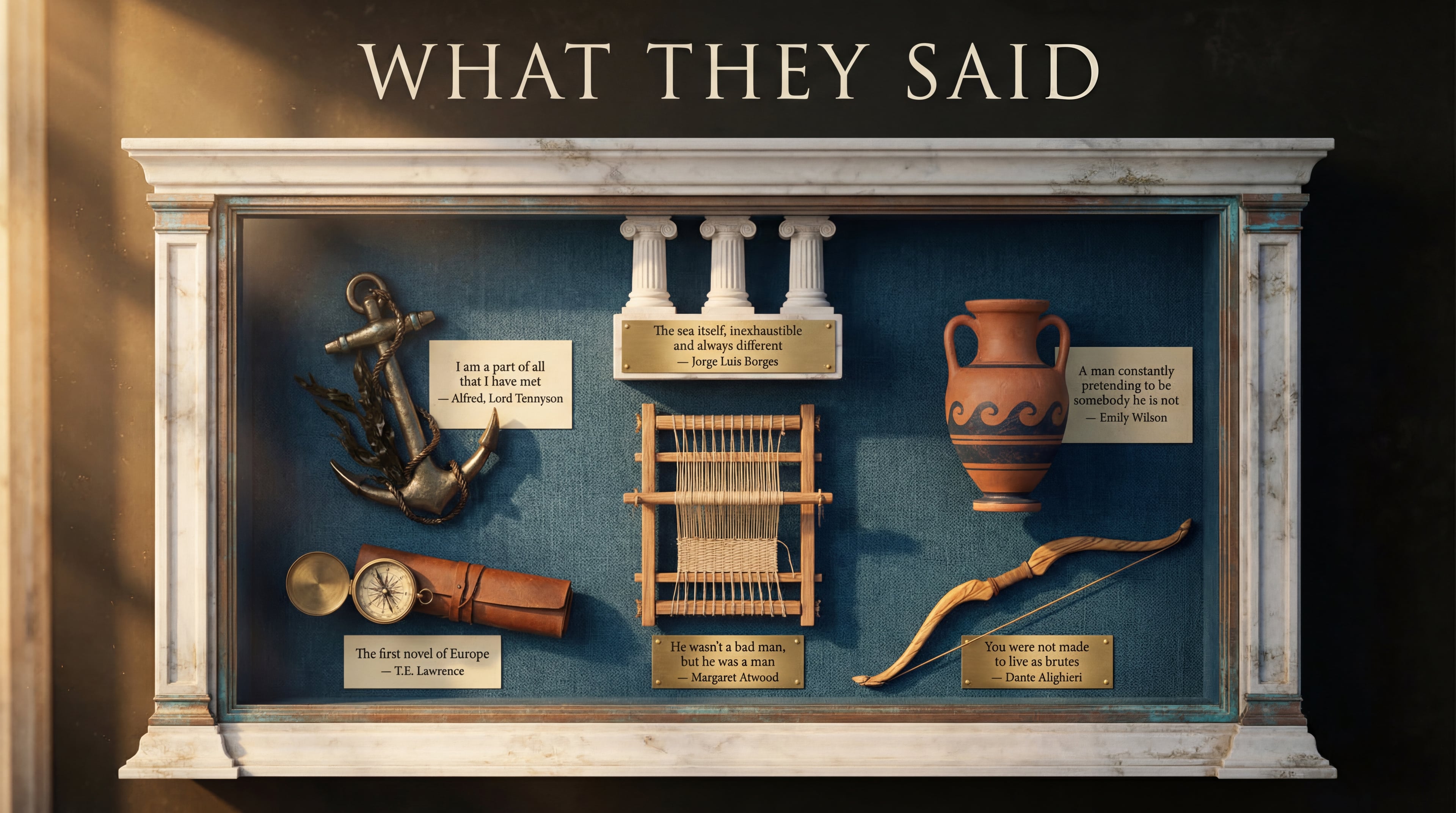
The Odyssey was not, for the Greeks, a book in the modern sense -- it was the sea itself, inexhaustible and always different.
I sing of arms and the man who, exiled by fate, first came from the shores of Troy to Italy.
I am a part of all that I have met; yet all experience is an arch wherethrough gleams that untravelled world whose margin fades for ever and for ever when I move.
Consider your origins: you were not made to live as brutes, but to pursue virtue and knowledge.
O Sun, great Eastern King, you too shall bow before the still unborn, before the mighty daughter of man, the human mind!
He wasn't a bad man, you understand, but he was a man, and men are always wanting things.
The Odyssey is a poem about a man who is constantly pretending to be somebody he is not, in a world where nobody is what they seem.
The Odyssey is the oldest book worth reading for its story, and the first novel of Europe.
Homer has taught all other poets the art of telling lies skillfully.
The Odyssey is the story of a man who -- unlike Achilles -- accepts the conditions of being human: aging, compromise, the need to be clever rather than strong.
See how the Odyssey connects to Ulysses, Hamlet, The Waste Land, Inferno, and more
Each layer reveals a different dimension of the text
Mythological, cultural, and linguistic context for Homeric terms
References to the Iliad, Theogony, and the wider mythological tradition
Homeric formulaic epithets: "rosy-fingered Dawn," "wine-dark sea," "man of many turns"
Mediterranean locations — real, debated, or mythical — on Odysseus’s voyage
Guest-friendship (xenia): the sacred bond between host and stranger, and its violations
Divine interventions: Athena’s aid, Poseidon’s wrath, Zeus’s omens
Narrative levels: Homer tells, Odysseus tells the Phaeacians, stories within stories
Passages referenced in scholarly debates and critical discussions
Connections to Ulysses, Inferno, Paradise Lost, and other works in the Universe
Three millennia of interpretation, mapped to the text
The 'Homeric Question' has haunted classical scholarship since antiquity. The Iliad and Odyssey differ in tone, vocabulary, theology, and narrative te...
Ancient scholars Aristophanes of Byzantium and Aristarchus declared that the 'end' (telos) of the Odyssey was the reunion of Odysseus and Penelope in ...
Odysseus is polytropos -- 'of many turns,' 'much-turning,' 'versatile.' He is the cleverest of the Greeks, but his cleverness shades into lying, manip...
Homeric terms with Greek original, transliteration, and meaning
Track Odysseus across the Mediterranean from Troy to Ithaca
See how Joyce mapped each Odyssey book onto his Dublin epic
Xenia layer traces the sacred bond of guest-friendship and its violations
Map every act of the gods: Athena’s aid, Poseidon’s wrath, Zeus’s omens
3D interactive graph of characters, places, and mythological connections
Navigate famous passages with narrative context — from "Nobody" to the bed of olive wood
Scholarly companions to the greatest works of literature
Bloomsday in Dublin
5 acts, 20 scenes
434 lines of modernism
34 cantos through 9 circles
One day in London, June 1923
18 chapters, three yoga paths
12 books spanning the cosmos
“I would rather be a paid servant in a poor man’s house and be above ground than king of kings among the dead.”
Achilles to Odysseus — Book 11