The 30,000-foot view
On the battlefield of Kurukshetra, the warrior prince Arjuna refuses to fight. His charioteer Krishna — who is God incarnate — responds not with a command but with a teaching: 700 verses that unfold the nature of duty, the self, the cosmos, and the paths to liberation. The dialogue moves from Arjuna's despair through the three yogas (action, devotion, knowledge) to Krishna's overwhelming self-revelation as the infinite divine, and finally to Arjuna's free choice to act. It is a conversation that has never ended.
The Gita was composed during a period of intense philosophical ferment in ancient India, when the ritual-focused Vedic tradition was being challenged by the world-renouncing movements of Buddhism and Jainism. The Gita's genius was to synthesize these tensions — affirming action in the world while teaching detachment from its fruits. It became the central text of Hindu philosophy, commented upon by Shankara, Ramanuja, and Madhva, and later embraced by Gandhi as his 'spiritual dictionary.'
The most widely read and commented-upon text in Hindu philosophy, the Gita has influenced thinkers from Thoreau and Emerson to Oppenheimer and Gandhi. Its teaching of desireless action (nishkama karma) offers a resolution to the universal tension between engagement and detachment. Read as ethics, theology, psychology, or war manual, it remains endlessly interpretable — each generation finding its own Arjuna, its own battlefield, its own Krishna.
Critics, authors, and cultural figures on the Bhagavad Gita
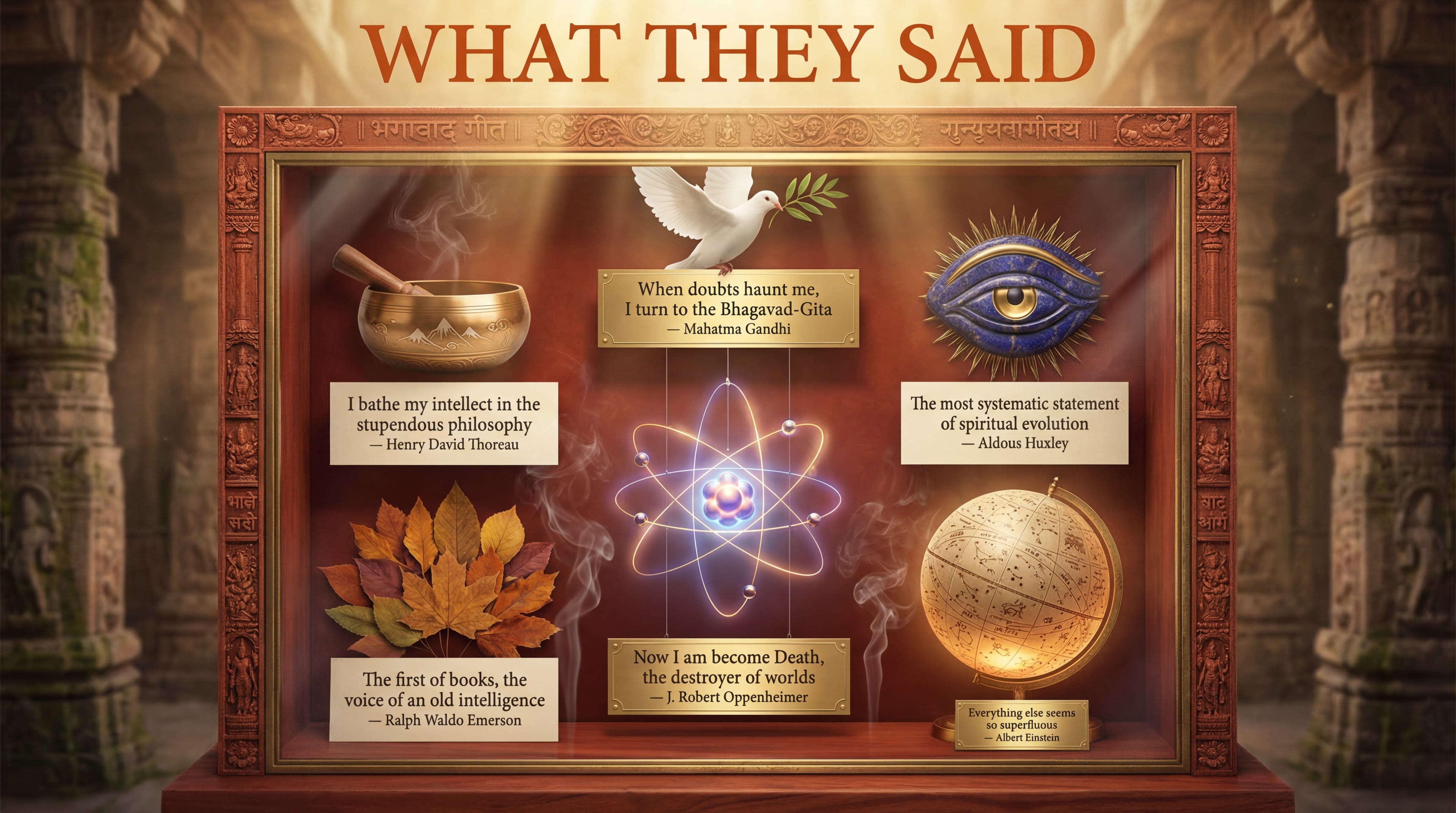
When doubts haunt me, when disappointments stare me in the face, and I see not one ray of hope on the horizon, I turn to the Bhagavad-Gita and find a verse to comfort me.
In the morning I bathe my intellect in the stupendous and cosmogonal philosophy of the Bhagvat Geeta, in comparison with which our modern world and its literature seem puny and trivial.
I owed a magnificent day to the Bhagavat Geeta. It was the first of books; it was as if an empire spake to us, nothing small or unworthy, but large, serene, consistent, the voice of an old intelligence.
Now I am become Death, the destroyer of worlds.
The Bhagavad-Gita is perhaps the most systematic statement of spiritual evolution of endowing a human body with a divine meaning ever known.
Perhaps the deepest and loftiest thing the world has to show.
A performance of great originality, of a sublimity of conception, reasoning, and diction almost unequalled.
The truly beautiful revelation of life's wisdom which enables philosophy to blossom into religion.
When I read the Bhagavad-Gita and reflect about how God created this universe, everything else seems so superfluous.
The Bhagavad-Gita is the next greatest philosophical poem to the Divine Comedy in the world's literature.
See how the Gita connects to Ulysses, Hamlet, The Waste Land, Inferno, and Mrs Dalloway
Each layer reveals a different dimension of the text
Sanskrit terms, philosophical vocabulary, and transliterations
References to Upanishads, Vedas, Mahabharata, and other sacred texts
The three yoga paths: Karma (action), Bhakti (devotion), Jnana (knowledge)
Scholarly commentaries from Advaita, Vishishtadvaita, Dvaita, and modern schools
Dialogue attribution: Krishna, Arjuna, Sanjaya, and Dhritarashtra
Passages referenced in scholarly debates and critical discussions
Reading guide — key verses, difficult concepts, narrative context
Connections to other works: Upanishads, Mahabharata, Buddhist and Jain parallels
Millennia of philosophical argument, mapped to the text
The Bhagavad Gita appears in the Bhishma Parva of the Mahabharata, interrupting the narrative just as battle is about to begin. Its philosophical dept...
For over a millennium, the greatest minds of Indian philosophy have disagreed on the Gita's ultimate message. Shankara reads it as pointing to imperso...
The Gita's setting is a battlefield, and Krishna's central argument persuades a reluctant warrior to fight. This has made the text a flashpoint for de...
Over 30 Sanskrit terms with transliteration and meaning
See which path (Karma/Bhakti/Jnana) each passage teaches
Visualize the nested narration: Sanjaya → Krishna → Arjuna
Four schools of interpretation: Advaita, Vishishtadvaita, Dvaita, Modern
Links to The Waste Land, Hamlet, Inferno, and more
3D interactive graph of characters, concepts, and philosophical schools
Navigate 18 famous passages with narrative context — enter the book at its most celebrated moments
Scholarly companions to the greatest works of literature
Bloomsday in Dublin
5 acts, 20 scenes
434 lines of modernism
34 cantos through 9 circles
One day in London, June 1923
24 books, the voyage home
12 books spanning the cosmos
“Thy right is to the work, not to its fruit.”
Chapter 2, Verse 47