The 30,000-foot view
A poet lost in a dark wood at the midpoint of his life is guided by the shade of Virgil through the nine circles of Hell — a vast funnel descending from the sins of incontinence through violence to the frozen lake of treachery at the earth's core. Each circle is a landscape of divine justice where the punishment mirrors the sin (contrapasso), and each encounter forces Dante to confront his own capacity for compassion, judgment, and the limits of human reason.
Written in exile after Dante's banishment from Florence in 1302 during the Guelf-Ghibelline factional wars. Dante chose to write in the Tuscan vernacular rather than Latin — a revolutionary act that essentially created the Italian literary language. The Comedy synthesizes Aristotelian philosophy, Thomistic theology, classical mythology, and contemporary Florentine politics into the most architecturally precise poem ever composed.
The Inferno is the founding text of Italian literature and one of the supreme achievements of the human imagination. Its vision of the afterlife has shaped Western culture's imagery of Hell for seven centuries. More than theology, it is a work of radical empathy — Dante weeps for the damned even as he affirms their justice. Its influence runs from Chaucer and Milton through Borges, Beckett, and every writer who has tried to give moral geography a physical form.
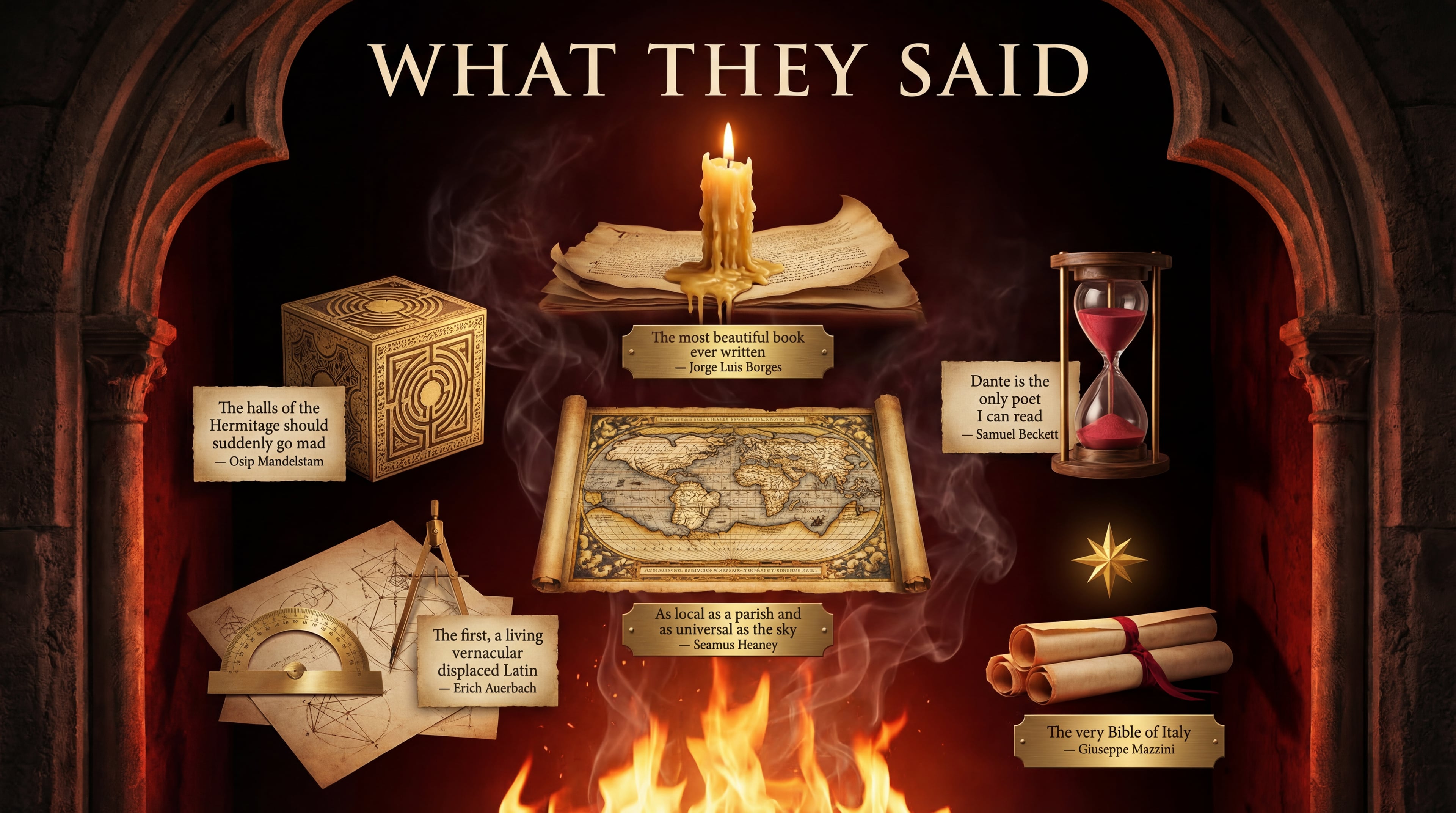
Critics, authors, and cultural figures on the Inferno
Dante is the most persistent and deepest influence upon my own verse.
The most beautiful book ever written. The Comedy is a book which everyone ought to read. Not to read it is to deprive oneself of the greatest gift literature can give.
Imagine that the halls of the Hermitage should suddenly go mad, that the paintings of all the schools and masters should break loose from their nails, and merge with one another — you would have something like the Comedy.
Dante and Shakespeare divide the modern world between them. There is no third.
Full of intimate placings and place-names — the Inferno is as local as a parish and as universal as the sky.
For the first time, a living vernacular displaced Latin as the language of high literature — and it was Dante who did it.
Dante is the only poet I can read.
Dante is a bridge thrown over the stream of time, which unites the modern and the ancient world.
It is, precisely, hell that is described — not a humanitarian protest, not a literary exercise, but a precise imagining of what hell would actually be.
The very Bible of Italy — a national poem in the deepest sense.
See how the Inferno connects to Ulysses, Hamlet, The Waste Land, Mrs Dalloway, and the Gita
Each layer reveals a different dimension of the text
Italian terms, theological vocabulary, archaic Longfellow English
Classical, biblical, and literary source references (Aeneid, Ovid, Bible)
Punishment-mirrors-sin mapping — the defining principle of Infernal justice
Scholarly critical readings from major Dante scholars
Real historical and mythological figures with era, dates, and significance
Passages referenced in scholarly debates
Reading guide — key passages, difficult tercets, narrative context
Dante’s own explanations from Convivio, Epistle to Can Grande, Vita Nuova
Connections to other works in the Literary Universe
Centuries of scholarly argument, mapped to the text
Dante the pilgrim faints from pity after hearing Francesca's story, yet Dante the poet placed her in Hell. This tension between emotional sympathy and...
In Canto XXVI, Ulysses tells of sailing past the Pillars of Hercules, urging his crew to 'follow virtue and knowledge.' He is punished among the fraud...
Two Dantes inhabit the poem: the younger man who faints at Francesca's story (Canto V) and weeps at the diviners' twisted bodies (Canto XX), and the m...
See how each punishment mirrors or inverts the sin — the defining principle of Dante’s infernal justice
150+ named characters from classical antiquity, the Bible, and medieval Italy with biographical context
Commentary from the Convivio, Epistle to Can Grande, and Vita Nuova — the poet explains his design
9 thematic categories detected in real time: darkness/light, fire/ice, pity/justice, metamorphosis, and more
A vertical descent through all 9 circles, from the Dark Wood to the frozen center of Hell
3D interactive graph of characters, places, concepts, and works — organized by circle depth
Navigate 9 famous passages with narrative context — enter the poem at its most celebrated moments
Scholarly companions to the greatest works of literature
Bloomsday in Dublin
5 acts, 20 scenes
434 lines of modernism
One day in London, June 1923
18 chapters, three yoga paths
24 books, the voyage home
12 books spanning the cosmos
“E quindi uscimmo a riveder le stelle.”
And thence we came forth to see again the stars.